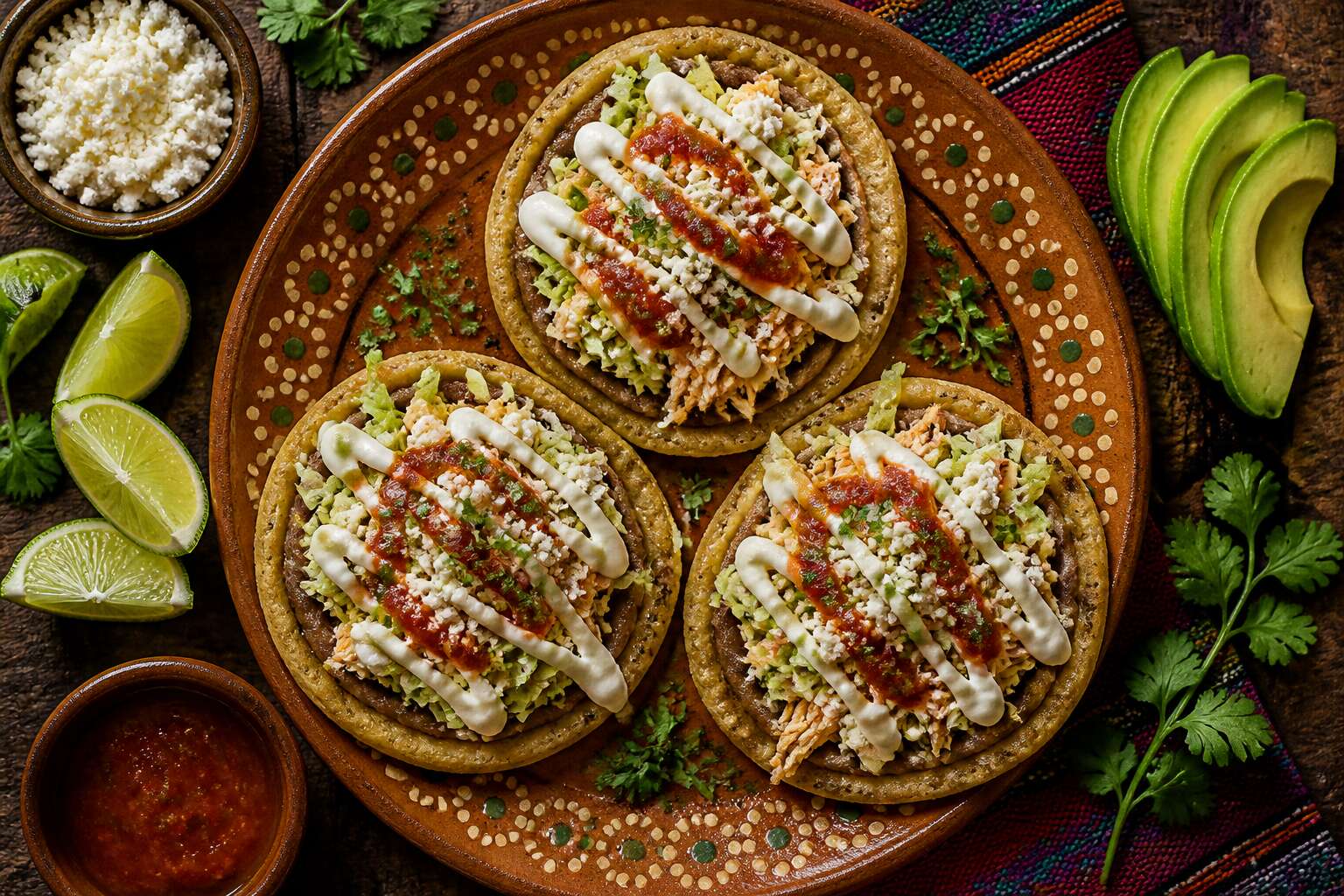
The Appeal of Sopes
The Crispy Base: A Perfect Canvas
Sopes are a cornerstone of mexican food like sopes, and the appeal starts with the base. The masa disk is fried until its exterior turns golden and crisp, creating a sturdy platform that holds toppings without turning soggy. This is no delicate tortilla. It demands a hearty bite.
The inner crumb stays soft and slightly moist, offering contrast with every mouthful. The pinched rim acts like a small wall, keeping beans, meat, and salsa exactly where they belong. That structural integrity provides a practical advantage. You can pile on layers without reaching for a fork.
Consider the construction sequence:
– The masa is pressed thick
– The edges are pinched upward
– The base is fried until golden
This technique produces the signature crunch. A well-made sope gives a gentle crack on first bite, then yields to the tender base. For anyone exploring mexican food like sopes, that crispy foundation makes the whole contraption work, and honestly, it is glorious.
The Pull of Hearty Toppings
There is a moment of quiet anticipation when a sope arrives at the table. For anyone seeking mexican food like sopes, the topping layer is the true draw. Refried beans form the first seal, gripping the meat above. Then comes the protein: chorizo, carnitas, or al pastor, each with its own smoky depth.
- Salsa roja or salsa verde for heat
- Crema for cooling contrast
- Crumbled queso fresco for salt
- Fresh onion and cilantro for brightness
The combination feels deliberate, almost ritualistic. Each topping has a role, and together they create a balance that keeps you coming back. I have eaten my share across Johannesburg’s expanding taqueria scene, and the finest versions use toppings prepared in small batches, with meats cooked slow and salsas left to develop overnight.
The Role of Masa in Flavor and Texture
Take a sope in your hand and notice the edges first. They are pressed, pinched, never identical. That visible imperfection is the appeal. A machine cannot produce it! The masa, made from nixtamalized corn, delivers a mineral sweetness no wheat tortilla can imitate. It also holds moisture in ways a fried shell cannot, keeping the interior tender beneath the outer crisp. For those seeking mexican food like sopes in Johannesburg, the masa is never a neutral base. It engages the palate through a defined sequence:
- The initial crunch that shatters cleanly
- The soft, humid interior that grips the refried beans
- The lingering corn finish that resurfaces after the heat subsides
This progression explains the deep pull of mexican food like sopes. The base yields just enough, then pushes back. This tension, held in every hand-pressed disc, is why I return.
Why Sopes Fit Any Meal of the Day
Few dishes adapt to the clock like a sope. In Johannesburg, a breakfast sope holds scrambled eggs and crema without losing its crunch, and the same disc at dusk supports braised beef and salsa verde. The pinched edges keep their integrity through both. This resilience is baked into its construction.
Consider the rhythm of a South African day and where mexican food like sopes inserts itself:
- Morning: a sturdy base that survives rush hour
- Afternoon: a self-contained meal for a working lunch
- Evening: a satisfying option after a long commute
The disc never demands ceremony. You can lace it with heat or keep it mild. It works with a fork or with bare hands, fitting any hour.
Building Blocks: Masa and Frying Techniques
Choosing the Right Masa for Sopes
Choosing the right masa for sopes is a quiet act of precision. The nixtamalized corn dough must be neither too wet nor too crumbly, as this balance dictates whether the edges will puff and crisp during frying. White maize yields a neutral base, while yellow adds a slight sweetness. Blue corn, though slower to hydrate, brings an earthy flavour that stands up to bold salsas.
Frying transforms the modest disk into a vessel with a crisp shell and tender interior. The oil temperature hovers around 350 degrees Fahrenheit, hot enough to set the exterior without drying the centre. A brief initial dip on one side, then a flip, encourages the characteristic rim to form.
- Fresh masa has a higher moisture content and yields a softer bite.
- Masa harina reconstructs into a sturdier base for heavier toppings.
- A pinch of salt in the dough sharpens the corn’s natural flavour.
These choices matter in mexican food like sopes, where the foundation either carries the toppings or collapses beneath them.
Nixtamalization Basics for Authentic Flavor
Every sope begins with nixtamalization. Soaking maize in slaked lime softens the hull and unlocks nutrients. For mexican food like sopes, this step gives the dough its flexibility and soul.
The building blocks are simple but demand patience! I have watched kernels swell in the pot, then rinse and grind them into a warm, pliant masa. Frying turns it into a sturdy vessel.
The process follows a clear order:
- Simmer corn in limewater.
- Rest overnight.
- Rinse and grind.
The result is a base that holds heavy toppings without breaking. Without nixtamalization, these little vessels would lose their character. The technique, though ancient, remains essential!
Shaping the Thick Shell by Hand
A sope shell begins as a handful of masa pressed flat between your palms. You pinch around the rim and turn the disc in your hand, coaxing the edges upward until a thick border forms. This manual shaping gives the base its signature depth, a rim that holds toppings without collapsing.
Shallow frying at medium heat completes the transformation. The oil crisps the exterior while the interior stays moist and pliable. If the fat is too hot, the shell puffs up; too cool, and it soaks up grease.
- Pinch from the outer edge, never the centre.
- Keep the rim uniform so toppings sit level.
- Fry in about one centimetre of oil.
The result, mexican food like sopes, offers a crisp bite with a soft, corn-sweet interior. Simple handwork, nothing plain about the outcome.
Achieving the Perfect Crisp Exterior
Perfecting the crisp exterior demands attention to the masa itself. The moisture level in the dough determines whether the shell shatters or chews. A drier mix, one that just holds together, produces the most reliable crunch. Resting the dough for twenty minutes relaxes the starches and encourages even browning. This small step makes a noticeable difference.
- Use white corn masa for a consistent crust.
- Let shaped shells rest five minutes before frying.
- Flip only once, when the edge turns golden.
Heat the oil to 190 degrees Celsius and lower the sope in gently. At this heat, the surface sets quickly while the interior steams softly. That is how mexican food like sopes achieves its signature contrast: a brittle shell, a yielding center.
Oil Temperature and Drainage Methods
The quiet truth about mexican food like sopes rests upon the oil’s exact heat. A single degree of deviation changes the final texture. For the masa, let it hold its shape but never cling to your palm. This balance dictates how the shell absorbs oil; a saturated sope grows heavy and sodden. Frying demands a stationary hand.
Maintain the oil at 180 to 190 degrees Celsius. Lower the sope with reverence. At this heat, the surface seals without trapping excess moisture. After two minutes, turn once. The golden edge signals the moment. Lift it, and drain with precision.
- The sope drains on a wire rack, never paper towels.
- Residual oil drips away naturally.
- Steam escapes without softening the crust.
This preserves the brittle character that defines the finished sope.
Classic Toppings and Creative Twists
Traditional Tinga and Refried Beans
Chicken tinga is the reason I choose sopes over tacos. It brings a smoky heat that settles into the masa shell. Shredded chicken simmered in tomato, chipotle and onion offers a contrast to the crisp base. Refried beans, spread warm underneath, add a creamy layer that holds everything together. I prefer the beans first, then the tinga, then a crumble of fresh cheese!
For classic toppings, stick to these:
– Shredded lettuce or cabbage for crunch
– Crema or thick yogurt for tang
– Salsa verde or roja for brightness
Creative twists work too. You can swap the chicken for mushrooms or use a smoky black bean tinga. Some cooks add pickled red onions or a drizzle of avocado oil. Mexican food like sopes depends on balance, so every topping needs to serve a purpose.
Fresh Options: Queso, Crema, and Escabeche
Fresh dairy and pickled elements carry the final layer. Queso fresco crumbles with a salty bite, while crema softens the heat. Escabeche, tangy pickled jalapeños and carrots, cuts through the richness. I stack them in a fixed order: queso first, crema next, escabeche last. The sequence changes the mouthfeel.
- Queso fresco for salt and crumble
- Crema for cooling tang
- Escabeche for vinegar heat
Mexican food like sopes depends on these contrasts. A splash of escabeche juice over the toppings brightens the masa. For a creative twist, swap in mango salsa or roasted corn instead of lettuce. Freshness controls the final bite.
Fusion Toppings: Avocado Slices and Blended Salsas
Avocado slices bring a soft, rich texture to the crisp shell. I slice them thin, never mashed, so each piece holds its shape against the weight of other toppings. A Hass avocado from a Johannesburg greengrocer works well, though any firm-ripe fruit will do.
Blended salsas offer a different route. Unlike pico de gallo, which stays chunky, a smooth salsa roja or salsa verde coats the sope. I use roasted tomatoes, dried chilies, and a clove of garlic. The blender turns them into a sauce that seeps into the masa edges.
For a fusion twist, I sometimes add:
- Avocado slices with a drizzle of lime and smoked paprika
- A blended salsa made with roasted butternut or pumpkin seeds
- Fresh coriander stirred into the salsa for brightness
These toppings change how mexican food like sopes feels. The avocado softens, the salsa clings, and the base stays sturdy. That contrast keeps every bite interesting!
Regional Variations Across Mexico
Central Mexico’s Sopes Rancheros
Central Mexico defines sopes rancheros with a rigid formula. This is the benchmark version, the one that sets expectations for the entire dish. When South Africans seek out mexican food like sopes, this style appears first.
The assembly follows a fixed order. Refried beans, often seasoned with epazote, anchor the base. Shredded beef or chicken sits next. Then comes a fringe of lettuce, crumbled queso fresco, and a streak of thinned crema. The salsa roja, usually guajillo based, waits on the side. In my view, that restraint makes the difference.
Each layer keeps its place. The shell stays crisp because nothing soaks into it. That discipline distinguishes central Mexico’s sopes rancheros from the wetter styles found elsewhere.
Oaxacan Empanadas de Maíz
Oaxaca takes a different route entirely with empanadas de maíz. These folded masa pockets share the same foundation as sopes, but they break assembly conventions completely. Instead of an open face, the shell folds over the filling like a calzone.
The filling goes in before cooking, not after. This is the crucial difference. Sopes rancheros layer beans, meat, and crema on a crisp base. Oaxacan empanadas seal everything inside raw masa. The griddle creates a crust that traps moisture within.
This changes how you eat them. No fork required. No balancing act. You pick one up and bite through the crisp exterior into the hot, saucy center.
For anyone exploring mexican food like sopes, I find the empanada offers a new format. Same masa, same ingredients, entirely different texture. The contrast between the blistered exterior and the soft interior delivers the real reward.
Yucatán’s Panuchos: A Stuffed Cousin
Yucatán offers panuchos, a stuffed cousin that bends the sopes formula. The masa shell gets a hidden layer of refried black beans before hitting the hot oil. This creates a puffed, crispy pocket with a soft interior.
For anyone exploring mexican food like sopes, panuchos provide a distinct contrast. Toppings sit on top like sopes, but the bean filling inside changes every bite. Common additions include pickled red onions, cochinita pibil, and sliced avocado. The process differs in one essential step: the filling goes inside first, not after frying. This simple shift alters the texture and the eating experience. That shift makes all the difference!
- Soft masa
- Black bean paste
- Crisp fry
- Bright toppings
These components work together to deliver a satisfying, compact meal. No balancing act required. You can hold a panucho with one hand and still taste every layer. Regional versions vary, but the core remains consistent.
Tlaxcala’s Rustic Sopes de Frijol
In Tlaxcala, the sopes de frijol stays minimal. The masa disc gets pressed thicker than in other regions, pinched into a raised rim, then fried until the edges turn crisp. A generous layer of refried beans covers the base. No tomato sauce, no shredded meat, just bean paste that blends into the warm corn surface.
Common extras:
- Crumbled queso fresco
- Salsa verde
- Thin slices of nopales
That is the whole assembly. Locals often eat these sopes straight from the comal, perhaps adding one spoon of crema.
For anyone sampling mexican food like sopes across Mexico, Tlaxcala’s rustic version shows that fewer ingredients can stand on their own. The beans merge into the masa, producing a unified bite where corn and legume flavors combine. Street food rarely gets more direct than this.
Southern Sopes de Cochinita
The Yucatán does not treat sopes gently. The masa disc is fried until blistered, then buried under shredded pork that has simmered overnight in achiote, sour orange, and garlic. The meat arrives stained crimson, its fat seeping into the warm corn surface.
I have watched vendors assemble these sopes with pickled red onion and a single habanero slice. The heat arrives late, after the pork has settled. Some add a spoon of black bean purée, others serve the cochinita without further adornment.
- Achiote lends the red colour
- Sour orange cuts through the pork’s heaviness
- Habanero brings a delayed burn
Crisp edges give way to a sodden centre. For anyone exploring mexican food like sopes across southern Mexico, this cochinita version does not apologise for its excess. It is mexican food like sopes at its most unyielding, demanding the full attention of the table!
Northern Influences: Carne Asada on Sopes
Northern Mexico approaches sopes with a different temperament. The carne asada version replaces slow-braised pork with thin cuts of beef seared over intense flame. Charred edges release a smokiness that sinks into the fried masa shell. In Sonora and Chihuahua, vendors season the meat with a dry rub of cumin and dried chiles.
Toppings remain restrained so the beef’s flavour leads. A few choices define the regional style:
- Grilled spring onions or rajas
- Salsa verde spooned over the top
- Crumbled queso fresco
For anyone seeking mexican food like sopes beyond the slow-cooked southern versions, this northern cousin offers a leaner, punchier bite. The thick corn base holds its structure under the meat’s juices without losing its crisp edge. It is a direct preparation that reflects the border region’s deep cattle culture.
Accompanying Sauces: From Salsa Roja to Avocado Crema
Salsa Roja: Smoky and Spicy
Salsa roja is the essential char of a sope. Roasted tomatoes, toasted guajillo, and a pinch of chipotle deliver smoky heat. Avocado crema provides cold, grassy richness. Together they balance each other, sharp and cool at once.
For mexican food like sopes, the sauce application matters as much as the recipe. A proper table spread includes:
- Salsa roja with pasilla for earthy depth
- Avocado crema laced with lime and cilantro
- A serrano salsa verde for bright acidity
Too much sauce softens the crisp base. Too little leaves the masa dry. The balance, struck by hand, separates a memorable sope from a forgettable one.
Salsa Verde: Tangy and Fresh
For mexican food like sopes, sauce is a finishing stroke. Salsa verde, from roasted tomatillos and serrano chiles, delivers tangy freshness that lifts the dense masa. Its acidity cuts through beans or tinga, letting each ingredient breathe.
Avocado crema adds different energy. Whipped with lime and cilantro, it drapes over the sope, rounding out sharp flavors. The contrast between crisp shell and chilled cream creates a satisfying pause.
- Salsa verde sinks into the bean layer, brightening each bite.
- Avocado crema stays cool and thick, balancing heat.
- A final drizzle of salsa roja adds smoke to the edges.
Apply sauces sparingly. The masa should remain crunchy. In mexican food like sopes, restraint is the mark of a skilled hand.
Salsa de Molcajete: Stone-Ground Depth
Salsa roja, built from dried chilies and tomatoes, adds a smoky heat that settles into every crevice of mexican food like sopes. Unlike salsa verde, it does not brighten; it anchors. Salsa de molcajete, crushed by hand in a volcanic stone bowl, takes this further. The grinding releases essential oils and leaves small chunks of chili and garlic. That coarse texture gives the sauce a rustic presence.
- Salsa roja rounds out the flavor with mild heat.
- Salsa de molcajete adds crunch and aromatic depth.
A spoonful of either transforms the sope’s thick masa, tying the topping together. Use them sparingly, letting the crisp base stay audible with each bite.
Crema de Aguacate: Cool and Velvety
When the conversation turns to sauces for mexican food like sopes, most attention falls on the red and green salsas. Salsa roja has its smoke, salsa verde has its tang. But the cool side of the table deserves equal time. Crema de aguacate is a soft, velvety blend of avocado, crema, and lime that offers immediate relief from spice. It does not compete with the heat. It sits beside it, smoothing the edges.
I like to spoon it over a sope right before serving. The warm masa melts the cream slightly, and the avocado taste stays fresh. It is a simple addition, but it changes the rhythm of the bite. After the crunch and the spice, the crema steps in with something calm.
Troubleshooting and Pro Tips for Home Cooks
Keep Masa Moist to Prevent Cracks
The number one culprit behind cracked sopes is dry masa. When the dough loses moisture before it hits the oil, the shell splits and the filling leaks through. I always test a small ball first: if the edges fracture when I press it flat, I add warm water by the teaspoon.
Keep a damp cloth draped over the masa bowl while you work. Portion each ball, then cover them again. The warmth and humidity work together to maintain that pliable texture.
- The surface looks matte rather than glossy
- Tiny fissures appear around the edges
- The dough feels tacky instead of smooth
For mexican food like sopes, the moisture balance determines everything. A hydrated masa yields a crisp exterior with a tender interior. Work quickly, but don’t rush the process. Your hands should feel the dough respond, and the reward is a shell that holds every topping without a single crack.
Avoid Overcracking the Shell
A cracked sope is a sad sight, but it is rarely a mystery. For home cooks making mexican food like sopes, the shell often splits because the masa gets worked too hard. Overkneading develops gluten, which makes the dough spring back and fracture. Press the ball gently between two sheets of plastic, then peel it off slowly. If the edges tear, your press is too forceful. Ease up and rotate the dough a quarter turn.
Watch the oil temperature as well. A sope that hits oil at 170°C sizzles too softly and absorbs grease, weakening the structure. At 190°C, the exterior sets instantly. Fry in small batches, one or two at a time, so the temperature never drops. Use tongs to flip once, and let the shell rest on paper towels. That rest is essential.
For consistent results, follow this order:
- Shape all the shells before heating any oil.
- Keep the shaped shells under a damp towel.
- Fry only when every shell is ready.
Warm the Toppings, Not Just the Base
A cold topping can undo the work of a perfectly fried sope. When you build mexican food like sopes at home, the shell holds its heat for only a few minutes. Refried beans straight from the fridge will cool the masa instantly. The same goes for tinga and other hearty fillings. Warm them before assembly, and the whole plate stays hot.
Here is the order I follow in my own kitchen:
- Heat the beans and protein on a comal or in a pan.
- Warm the salsa in a small pot, not the microwave.
- Keep the toppings covered until the shells come out of the oil.
The crema and cheese stay cool. That contrast is intentional! Serve on a warm plate, and the sope eats the way it should. The shell stays crisp, the toppings stay hot, and every bite lands at the right temperature.
Make-Ahead Strategies for Stress-Free Serving
A sope that crumbles mid-bite is a common problem when making mexican food like sopes. The shell often fails because the masa dried out before it hit the oil. The fix is a make-ahead tactic. Shape your patties, stack them with damp paper towels, and refrigerate. They hold for up to eight hours. You can also fry the shells a few hours ahead. Let them cool completely, then store them in a single layer on a tray. Re-crisp them in a hot oven for five minutes. This restores the crunch without hardening the base. My preferred order for a stress-free evening:
- Fry the shells early.
- Warm the beans and protein right before assembly.
- Keep the crema and cheese cold until the final minute.
That sequence keeps the components distinct. The shells stay crisp, the fillings stay hot, and the contrast remains intentional. When you make mexican food like sopes this way, the cooking becomes a calm process rather than a last-minute scramble.

0 Comments